
U.S. Government Services
A PROUD RELOCATION MANAGEMENT PROVIDER TO THOSE SERVING OUR COUNTRY
Since 1984, Sirva, dba BGRS, Inc. (“BGRS”), has been a trusted advisor and partner to the nation’s top federal agencies. Our decades-long history of serving the U.S. government is backed by our unparalleled experience in conforming to both the Federal Acquisition Regulation (FAR) and Federal Travel Regulation (FTR) and our deep understanding of the General Services Administration’s (GSA’s) stringent relocation policy requirements and guidelines.
Since the award of our first Government contract in 1984, we have supported 40+ federal and quasi-governmental agencies and managed more than 147,500 U.S. federal moves. We have also expertly handled 280,000 moves for the Canadian Government over the past 15 years.

OUR EXPERIENCE HAS YOU COVERED
As the relocation industry’s leading federal contractor, we offer complete, reliable relocation services in full compliance with the GSA Schedule 48 and all U.S. government contracting requirements. We value our long-standing relationship with the U.S. government and take our responsibility to the federal agencies and employees we serve seriously.
Highlighting our experience and leadership in serving the government sector, we have proudly played a key role in the following federal community forums for many years:
- Senior Executives Association (SEA) Corporate Advisory Council: Serve as an advocate for our government clients’ relocation interests to federal leaders.
- Government Relocation Advisory Board (GRAB): Served as an active member focused on transforming the relocation provisions of the FTR.
Our agency clients are governed by the highest ethical standards and quality control elements:

GOVERNMENT-TRAINED AND GOVERNMENT-CLEARED PERSONNEL:
All dedicated team members are U.S. citizens and hold or are in the process of obtaining Position of Public Trust security clearances.

STRINGENT SECURITY PROTOCOLS:
All systems, facilities, personnel, and data accessibility are U.S-based and carefully constructed to adhere to government standards and protect the sensitive information entrusted to us.

SECURE RELOCATION MANAGEMENT PORTAL:
Adheres to the highest global standards for data security with multi-factor authentication, biometrics, and user-level validation.

PROPRIETARY GCERTIFIED™ PROGRAM:
All dedicated government team members and service partners are required to participate in a Sirva, dba BGRS-developed course to learn FTR/FAR requirements and understand government culture.
Sirva, dba BGRS, Inc., stands as a steadfast and proud relocation service partner to the U.S. government. With a commitment to excellence, efficiency, and unparalleled service, we have consistently demonstrated its ability to meet the unique needs and challenges of government-sponsored relocations. Through innovative solutions, rigorous adherence to compliance, and a dedicated team of professionals, we ensure that every relocation undertaken in partnership with the U.S. government is executed with precision and care.
MORE THAN A MOVER
In addition to providing relocation management services, we play a pivotal role in supporting U.S. federal government agencies in crafting relocation strategies that seamlessly integrate with overarching talent management objectives. By leveraging our expertise and experience in mobility solutions, we ensure that relocation initiatives align closely with broader talent management goals.

SPOUSE AND PARTNER ASSISTANCE:
We provide personalized services to help facilitate integration into the new community, such as mentor and support networks and career assistance, which may include resume writing and interviewing, introductions/networking opportunities, and traditional job placement services in the destination location.
CAREER ADVANCEMENT:
We support a mobile employee's career advancement through a range of relocation service solutions and policies designed to facilitate professional growth and development. We enable mobile employees to seamlessly transition to new roles and opportunities while supporting their long-term professional success within the organization.


Employee Retention:
We contribute to our government clients’ employee retention by facilitating smooth transitions and providing personalized support throughout the relocation process, enhancing job satisfaction, maintaining loyalty, and safeguarding institutional knowledge.
By connecting relocations with these critical goals, Sirva, dba BGRS, not only facilitates efficient moves but also actively contributes to the long-term success and effectiveness of U.S. federal government agencies' talent management strategies.
As we look towards the future, we remain unwavering in our dedication to facilitating seamless transitions for government employees and their families, thereby upholding our shared commitment to service, integrity, and excellence.

RELOCATION SERVICES
We have been authorized by the GSA to provide the following relocation services to the federal government under Schedule Title: Transportation, Delivery & Relocation Services; SIN 531 (Schedule 48); Contract number: GS-33F-001HA.
The following Multiple Award Schedule (MAS) outlines the Special Item Numbers (SINs) we are approved to provide to the U.S. government:

653-1 Home Sale

653-4 Entitlement Counseling

653-1B Marketing Assistance

653-5 Agency Customizes Services

653-5 Property Management

653-7 Move Management
For a complete history and listing of services, please refer to our GSA-Approved Catalog.
The Two-Week Blitz: What a Room of Mobility Leaders Taught Us About GCC Growth in India


WERCshop Bengaluru Problem-Solving Clinic
Every Global Capability Center (GCC) operating in India eventually gets this email. A business unit needs an expanded team. A capability decision becomes a hiring decision becomes a mandate. And somewhere in that chain, Mobility is told the start date: ten business days from now.
At WERCshop Bengaluru, Sirva and Intuit built a Problem-Solving Clinic around exactly this moment, not as a hypothetical, but as a scenario every GCC leader in the room recognized on sight. The session, co-hosted by Sirva's Sharmila Raghuvaran and Intuit's Saheli Paul, split twelve tables of corporates, RMCs, suppliers, and local DSPs into two working groups. One group solved the delivery problem in front of them, and the other stepped back to solve the decision problem behind it.
The Scenario
A bulk hire of engineers needs to move from the National Capital Region (NCR) region into Bangalore. The business has committed to clients and project timelines around a start date that cannot move. Mobility's standard lead time is four to six weeks. In this scenario, they have ten business days.
The operational friction that follows is familiar to anyone who has managed a compressed move: flight bookings that create a domino effect on temporary accommodation and destination services, housing shortages in a market where quality corporate housing is already in short supply, and a cohort that ranges from single movers to families with school-aged children and dependent parents, each with genuinely different needs and timelines.
This is not a one-off crisis. As GCC investment in India accelerates, compressed mandates like this are becoming the operating norm, not the exception.
What the Room Solved: The Delivery Problem
The tables working the delivery challenge converged on a strikingly consistent playbook. Move the employee first. Contain costs by delaying family travel. Provide a lump sum, roughly fourteen days of sustenance, to help employees absorb origin-side obligations like leases and car loans while the move is underway. Once permanent housing is secured, bring the family over and stage the household goods move separately.
One table framed it simply: identify what has to happen in the first ten days, and what can safely happen after. Another added a risk-management layer: when a single property cannot accommodate the group on short notice, be prepared to split the cohort across multiple corporate housing options rather than delaying the move.
The throughline across every table was the same. Stage first, settle later. Protect the business timeline without asking families to absorb a chaotic, unmanaged transition.
What the Room Solved: The Decision Problem
The second group asked a harder question: how does Mobility stop being the team that executes decisions and start being the team that shapes them?
The answer that emerged, independently, from multiple tables, was data. "I'm going to pull the data from a single source," one participant explained, "this is the move that happened in these many days, and this is the outcome." Reproducible dashboards, showing historical timelines, costs, and results, were described as the real currency for earning a seat at the table before a mandate is locked.
Several tables went further, calling for a formal notification trigger: the moment a business decision creates movement, not once the start date is set, Mobility should be in the room. One mature program described maintaining a location-specific wiki of immigration, tax, and housing red flags, built proactively so business leaders can self-serve basic answers before escalating.
One table added an important counterweight to this enthusiasm for playbooks and roadmaps: the risk of overcommitting. A blueprint is only useful if it reflects what the organization can realistically deliver, not an aspirational standard that collapses under its own weight the first time reality doesn't cooperate. Early involvement should build credibility, not create new promises Mobility can't keep.
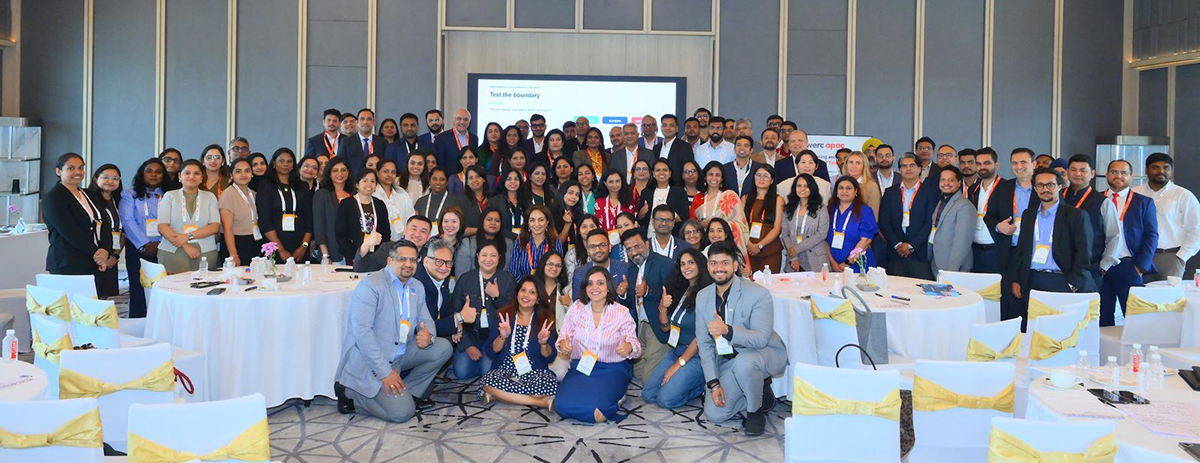
WERC Bengaluru Attendees
The Sharpest Insight of the Day
One exchange captured the real stakes for every GCC in India. A participant who had helped set up GCCs for multiple clients observed a pattern: the most experienced GCC leaders put Mobility on the agenda from day one, alongside real estate, technology, and talent strategy. Less experienced leaders treated Mobility as an afterthought, something that showed up only once hiring was already underway.
The difference in outcome was stark. In the first model, Mobility helps design how international and domestic movement will work before the first employee ever needs to relocate. In the second, Mobility inherits a structure it had no hand in shaping, and spends every subsequent quarter firefighting instead of planning.
This isn't limited to GCC setups. One table extended the same logic to mergers and acquisitions, arguing Mobility belongs on the cross-functional team from the start of any M&A process, not brought in afterward to execute a workforce plan it never helped design. Another table pushed the blueprint itself further, arguing that a genuine roadmap has to cover more than policy and logistics. It needs to address cultural fit and local integration too, helping new arrivals build local contacts and adapt to local culture, not just get them housed and onboarded.
As India continues its shift from hosting satellite support offices to hosting genuine decision-making centers, with R&D, product development, and global capability increasingly built in-country, this distinction will only matter more.
The Bigger Lesson
It would be easy to walk away from this session with a tactical checklist: lump sums, staged moves, pre-approved SLAs. Those are useful, and genuinely needed. But the aim of the clinic was never only to solve a ten-day fire drill. The aim was to solve the immediate delivery challenge without losing sight of the bigger lesson the room arrived at together: Mobility adds the most value when it is visible early, trusted as a decision partner, and able to shape employee-centered outcomes before the clock starts.
Global Capability Centers reflect how India is evolving, from a destination for operational support to a hub of global innovation, leadership, and decision-making. And as GCCs continue to grow at an unprecedented pace, the question is whether our mobility ecosystem is evolving fast enough to support that ambition.
The future of GCC growth in India will not be defined by how quickly we can move talent alone, but by how effectively we anticipate, enable, and sustain that movement. The opportunity for Global Mobility is no longer just to keep pace with business growth. It is to help shape it.
And perhaps that is the biggest takeaway from our Bengaluru workshop: Global Mobility shouldn't be brought to the table when the clock starts ticking. We need to be at the table when the decisions are being made.
If you have any questions on this session, or you would like to discuss how your Mobility team can be part of the decision making process, please contact us or reach out to your Sirva representative.
Sirva co-hosted this Problem-Solving Clinic with Intuit at WERCshop Bengaluru, bringing together over 120 corporates, suppliers, and service providers to work through the realities shaping talent mobility in India's fastest-growing market.
Smart. Helpful. Human. Responsible.